Pressure Vessel Protective Coating, Yorkshire

THE PROBLEM

Failure of Existing Protective Coatings

The existing protective coatings on the pressure vessel had reached the end of their service life, resulting in visible pitting, laminate corrosion and reduced long-term corrosion protection.
Because the vessel is in an area with active chemical processes, the steelwork had become contaminated with chemical salts, increasing environmental corrosivity and accelerating deterioration.

To maintain safe operation and prevent further structural degradation, the client required a complete replacement industrial protective coating system engineered for harsh, high-corrosivity environments.

THE SOLUTION

High-Durability Polyurethane Protective Coating System

Given the aggressive on-site conditions, we specified a high-build, solvent-free polyurethane protective coating system applied to a nominal thickness of 1000 microns. In accordance with ISO 12944, this coating specification provides very high durability (25+ years), even in a C5 corrosivity environment, making it ideal for long-term corrosion protection of industrial vessels.

Stage 1 – High-Pressure Washing & Contamination Removal

Pressure Vessel Protective Coating 05

The vessel’s surface was heavily contaminated with salts and chemical residue, so the first step was thorough high-pressure washing to remove contaminants, debris and poorly adhered remnants of previous coatings.

Pressure Vessel Protective Coating 06

Because the original coatings had been applied poorly, large areas detached during the cleaning process.

To control environmental conditions before blast cleaning, dehumidifiers were installed to reduce humidity and prevent flash rusting on exposed steel.

Stage 2 – Abrasive Grit Blasting to SA2.5

All remaining coatings were removed, and the steel substrate was prepared to SA2.5 in line with ISO 8501-1, ensuring an optimal surface profile for long-life industrial coating systems.

Pressure Vessel Protective Coating 11

A surface profile needle gauge was used to verify the required anchor profile. Following removal of existing coatings, soluble salt testing was carried out to ensure the surface was free from contaminants that could compromise the new coating system.

If salts had been detected, the steel would have required further washing and re-blasting — a critical step in preventing osmotic blistering and premature failure of high-performance protective coatings.

Stage 3 – Climate Condition Monitoring

Pressure Vessel Protective Coating 12

Throughout all stages of surface preparation and coating application, climatic conditions were continuously monitored and recorded (temperature, humidity, dew point) to ensure compliance with manufacturer requirements and coating performance standards.

Stage 4 – Application of High-Build Polyurethane Coating

Pressure Vessel Protective Coating 13

A solvent-free, high-build polyurethane coating was applied in two full coats to achieve the specified 1000-micron dry film thickness.  A separate stripe coat was used on welds, edges and sharp geometries where coatings typically draw thin due to surface tension.

Pressure Vessel Protective Coating 14

Dry Film Thickness (DFT) readings were taken and documented throughout the process to ensure full coating integrity and compliance with specification.

Stage 5 – Aliphatic Polyurethane Topcoat Finish

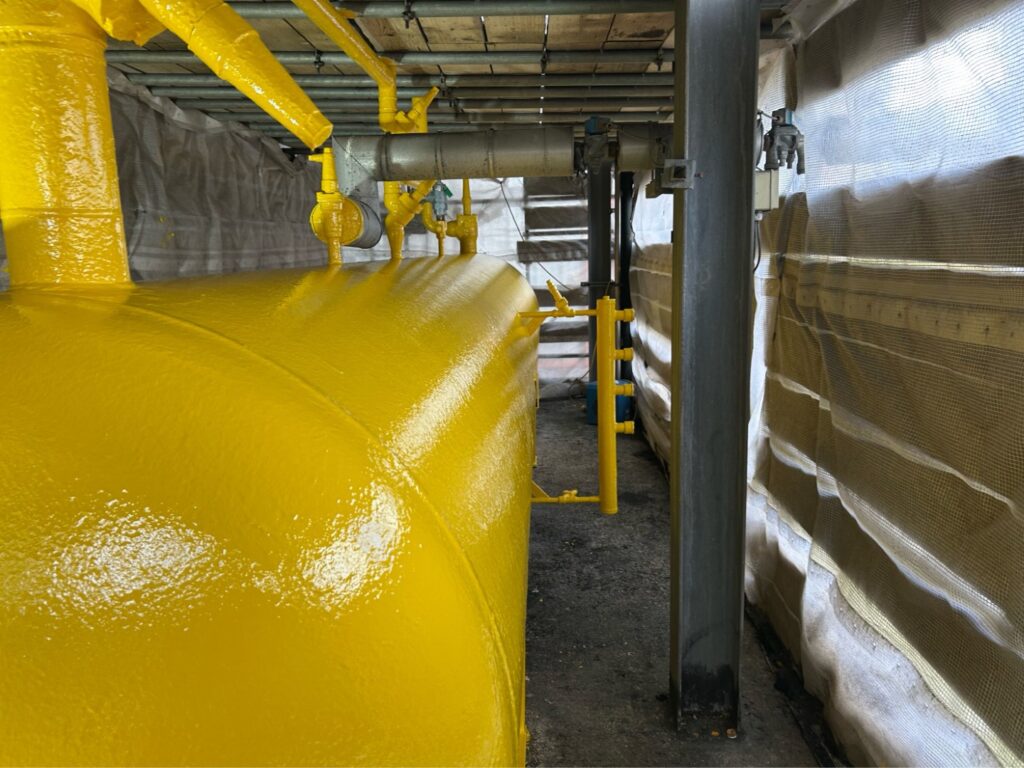
To complete the system, an aliphatic polyurethane topcoat was applied in the required colour to match the client’s pipework colour scheme.  This topcoat provides enhanced UV stability and a high-quality, durable finish suitable for demanding industrial environments.

Outcome — Long-Term Corrosion Protection Achieved

The vessel now benefits from a robust, fully compliant industrial protective coating system engineered for long-term performance in a C5 corrosivity environment. Through correct surface preparation, salt testing, climate control and the use of a high-build polyurethane system, the asset has been restored to a high-durability condition with extended service life.

Have a similar project? Get in touch today